
Compare AEO tools for content optimization, AI visibility, technical SEO, question research, structured data, and performance measurement.
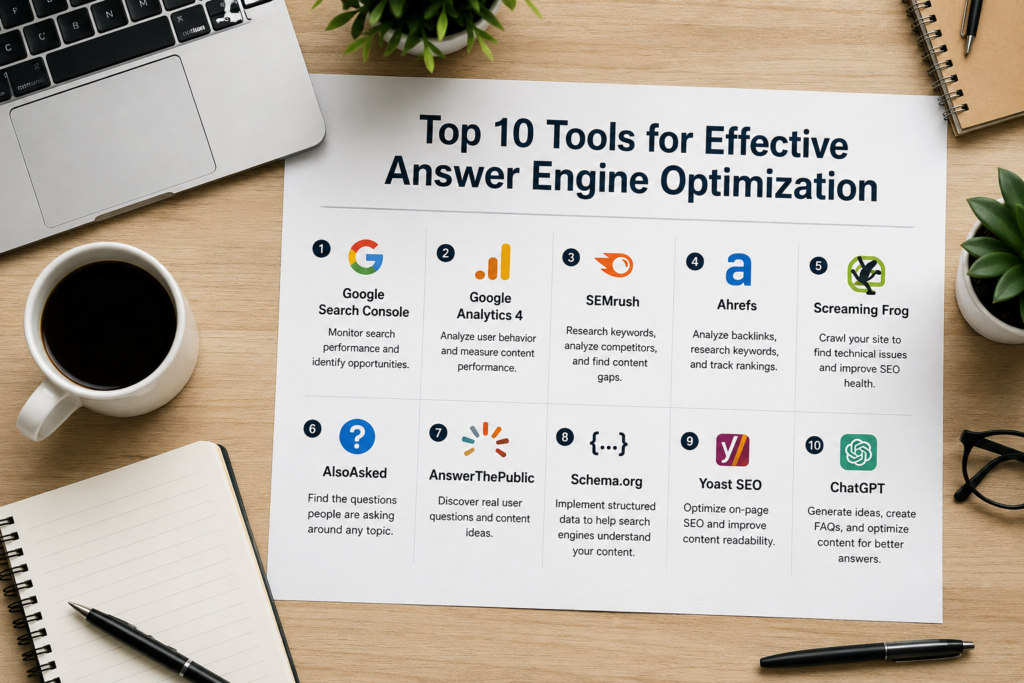
What Are the Best Answer Engine Optimization Tools?
The best Answer Engine Optimization (AEO) tools help businesses understand the questions people ask, create content that provides clear answers, strengthen technical search signals, monitor visibility, and measure how content performs across traditional and AI-driven search.
There is no single tool that handles every part of AEO. A strong AEO strategy typically combines tools for question and keyword research, content optimization, technical SEO, structured data, analytics, authority building, and AI visibility measurement.
Below are 10 tools and platforms that can support different parts of an effective AEO strategy.
What Is Answer Engine Optimization (AEO)?
Answer Engine Optimization is the process of making content easier for search engines, AI-powered platforms, answer engines, and voice assistants to understand, extract, trust, and potentially present as an answer.
Traditional SEO primarily focuses on improving visibility in search results. AEO expands that goal by helping businesses create information that can directly answer the questions their audiences are asking.
AEO can help improve a business’s ability to appear across environments such as Google Search and AI-powered search experiences, ChatGPT, Gemini, Perplexity, Claude, voice assistants, and other answer-driven platforms.
Effective AEO content should be:
- Clear and easy to understand
- Structured around real questions
- Accurate and current
- Supported by credible expertise
- Easy for search engines to crawl and interpret
- Written for people first
- Organized with useful headings, lists, tables, FAQs, and concise answers when appropriate
Quick Comparison of AEO Tools
| Tool | Best For |
|---|---|
| Google Search Console | Search queries, rankings and indexing |
| Google Analytics 4 | Engagement and conversion measurement |
| Semrush | Keyword, competitor and content research |
| Ahrefs | Backlinks, authority and competitive research |
| Screaming Frog | Technical SEO and website crawling |
| AlsoAsked | Question and search-intent research |
| AnswerThePublic | Audience questions and content ideas |
| Schema.org | Structured-data standards and guidance |
| Yoast SEO | WordPress on-page and technical optimization |
| ChatGPT | Research assistance, content ideation and restructuring |
The best combination depends on your website, audience, goals, budget, and existing marketing technology.
1. Google Search Console
Google Search Console provides direct information about how a website performs in Google Search.
Key AEO uses
- Discover questions and search queries generating impressions
- Identify pages receiving visibility but few clicks
- Monitor average search positions
- Check indexing
- Identify technical search issues
- Find content with optimization opportunities
Best for: Search visibility, query discovery, indexing and performance monitoring.
For example, a page receiving thousands of impressions but very few clicks may already have topical relevance. Search Console can help determine whether the problem is ranking, search intent, click-through rate, or a combination of factors.
2. Google Analytics 4
Google Analytics 4 helps businesses understand what visitors do after arriving on their websites.
Key AEO uses
- Measure engagement
- Analyze landing-page performance
- Track conversions
- Understand user journeys
- Evaluate content effectiveness
- Compare traffic sources
Best for: Measuring whether search and AI visibility ultimately produces meaningful business results.
Visibility alone isn’t enough. Businesses should also understand whether visitors engage, inquire, schedule appointments, download resources, or complete other important actions.
3. Semrush
Semrush provides SEO, competitive research, keyword research, content, and visibility capabilities.
Key AEO uses
- Keyword and topic research
- Competitor analysis
- Content-gap identification
- Position tracking
- Backlink research
- Search visibility analysis
Best for: Competitive research and strategic content planning.
Semrush can help identify where competitors are earning visibility and where your business may have opportunities to provide stronger answers.
4. Ahrefs
Ahrefs is particularly useful for researching backlinks, competing content, keywords, and website authority.
Key AEO uses
- Backlink analysis
- Competitive research
- Keyword research
- Content opportunity discovery
- Authority analysis
- Link-building research
Best for: Building and evaluating authority signals.
Strong content is important, but search and AI visibility also depend on whether a business demonstrates credibility and authority across the web.
5. Screaming Frog SEO Spider
Screaming Frog crawls websites and helps identify technical problems that can interfere with search visibility.
Key AEO uses
- Find broken links
- Review titles and metadata
- Analyze redirects
- Identify canonical issues
- Review crawlability
- Inspect structured data
- Discover duplicate or missing elements
Best for: Technical SEO and website auditing.
Before search engines or AI systems can effectively use website content, the underlying website needs to be accessible, crawlable, organized, and technically sound.
6. AlsoAsked
AlsoAsked helps uncover related questions people search for around a particular topic.
Key AEO uses
- Discover audience questions
- Identify related search intent
- Develop FAQ sections
- Build content clusters
- Find supporting article ideas
- Create question-based headings
Best for: Building answer-focused content.
This is particularly valuable for AEO because effective answer optimization begins with understanding what people actually want to know.
7. AnswerThePublic
AnswerThePublic helps uncover questions and phrases associated with topics people search for.
Key AEO uses
- Question discovery
- Long-tail topic research
- Content planning
- Audience-intent research
- FAQ development
Best for: Discovering questions and expanding content ideas.
The resulting questions can become article topics, FAQ sections, service-page content, videos, social posts, and other educational resources.
8. Schema.org
Schema.org is not an AEO software platform in the traditional sense. It provides the vocabulary used for structured data that helps search engines interpret information on webpages.
Key AEO uses
Structured data can describe information such as:
- Organizations
- Services
- Articles
- People
- Products
- Events
- Videos
- Other defined content types
Best for: Helping search engines understand the meaning and relationships within website content.
Structured data should accurately represent content that actually appears on the page. It should support clear website architecture rather than serve as a substitute for useful content.
9. Yoast SEO
Yoast SEO provides WordPress tools for managing many important on-page and technical SEO elements.
Key AEO uses
- SEO titles and meta descriptions
- XML sitemaps
- Canonical URLs
- Schema implementation
- Readability guidance
- On-page optimization
Best for: WordPress websites that need an accessible way to manage foundational SEO elements.
Yoast can support AEO, but installing an SEO plugin alone does not make a website optimized for answer engines. Content quality, structure, authority, technical accessibility, and user intent still matter.
10. ChatGPT
ChatGPT can assist with several parts of an AEO workflow when used with human review and reliable source material.
Key AEO uses
- Brainstorm audience questions
- Organize content
- Develop FAQ ideas
- Identify gaps in existing content
- Rewrite complicated explanations more clearly
- Develop content outlines
- Explore conversational ways customers may ask questions
Best for: Content research assistance, ideation, organization and refinement.
AI-generated information should be reviewed for accuracy, relevance, originality, and alignment with your business’s actual expertise. AI should support subject-matter expertise, not replace it.
Which AEO Tool Is Best?
There isn’t one best AEO tool for every business.
The better question is: Which tools solve the specific parts of AEO your business needs help with?
For example:
- Search performance: Google Search Console
- Website behavior and conversions: Google Analytics 4
- Competitive and keyword research: Semrush or Ahrefs
- Technical website auditing: Screaming Frog
- Audience-question research: AlsoAsked or AnswerThePublic
- Structured data: Schema.org guidance and appropriate implementation tools
- WordPress optimization: Yoast SEO
- AI-assisted content workflows: ChatGPT
Small businesses don’t necessarily need every tool on this list. A smaller technology stack used strategically can be more valuable than paying for multiple platforms without a clear plan.
How to Use AEO Tools Together
Step 1: Find the Questions Your Audience Is Asking
Start with Google Search Console, AlsoAsked, AnswerThePublic, keyword research tools, customer conversations, sales questions, and other first-party information.
Look for questions connected directly to the problems your business solves.
Step 2: Identify Existing Visibility Opportunities
Review pages already receiving Google impressions.
A page receiving impressions is providing an important signal: Google has associated that page with particular searches.
Determine whether the page needs stronger content, better search-intent alignment, greater authority, improved internal linking, or technical improvements.
Step 3: Create Direct, Useful Answers
Don’t make visitors search through several paragraphs before receiving the information promised by the headline.
Answer important questions clearly, then provide supporting detail.
Step 4: Strengthen Content Structure
Use descriptive headings, concise paragraphs, lists, comparison tables, definitions, FAQs, and step-by-step instructions when they genuinely make information easier to understand.
Step 5: Strengthen Technical Foundations
Review crawlability, indexing, canonicalization, internal links, structured data, page performance, and other technical signals.
Great content cannot perform effectively if search engines have difficulty accessing or interpreting it.
Step 6: Build Trust and Authority
Demonstrate real expertise through:
- Original insights
- First-hand experience
- Helpful examples
- Expert authorship
- Quality references
- Reviews and testimonials
- Consistent business information
- Relevant third-party mentions and backlinks
Step 7: Measure Business Results
Track more than rankings.
Measure impressions, clicks, engagement, leads, conversions, AI referrals, branded searches, citations, mentions, and other signals relevant to your business goals.
Frequently Asked Questions About AEO Tools
What is an AEO tool?
An AEO tool is a tool or platform that supports one or more parts of Answer Engine Optimization, such as question research, content optimization, technical SEO, structured data, authority analysis, search monitoring, or AI visibility measurement.
Are AEO tools different from SEO tools?
Sometimes. Many traditional SEO tools remain valuable for AEO because technical accessibility, content quality, authority, and search intent still matter. AEO adds greater emphasis on direct answers, conversational queries, machine understanding, and visibility in answer-driven and AI-powered environments.
What are the best AEO tools for small businesses?
The best combination depends on the business. Google Search Console and Google Analytics provide valuable first-party information without requiring an expensive enterprise platform. Additional tools can then be added based on specific needs such as technical auditing, question research, competitive intelligence, or AI visibility.
Can AEO tools get my business mentioned by ChatGPT?
No tool can guarantee that a business will be mentioned, cited, or recommended by ChatGPT or another AI platform. AEO tools can help businesses improve the content, technical accessibility, authority signals, and digital presence that contribute to overall search and AI visibility.
Do I still need SEO if I’m doing AEO?
Yes. SEO and AEO overlap substantially. Search engines and AI-driven discovery still depend on accessible websites, strong content, authority, clear entities, and useful information. AEO should complement a strong SEO foundation rather than replace it.
Final Thoughts
Answer Engine Optimization isn’t about finding one piece of software that makes a business visible everywhere.
It requires a connected strategy.
The right combination of tools can help you understand what your audience is asking, create better answers, improve website structure, strengthen authority, monitor visibility, and measure whether that visibility produces business results.
For small and mid-sized businesses, the goal isn’t to use every available platform. It is to understand where visibility is being lost and use the right tools and strategy to close those gaps.
Ready to Improve Your Business’s Answer Engine Visibility?
Knowing which AEO tools to use is only part of the process. The bigger challenge is knowing what to optimize, where your visibility gaps are, and how to turn SEO, AEO, and GEO into a coordinated strategy.
CJ Design & Consulting helps small and mid-sized businesses improve how they are found, understood, cited, and recommended across traditional search engines and AI-powered platforms.
Our Answer Engine Optimization services can help you:
Identify AEO and AI visibility opportunities
Optimize content around the questions your customers are asking
Improve website structure and technical search signals
Strengthen authority and trust signals
Connect SEO, AEO, and GEO into one visibility strategy
Measure whether increased visibility is producing meaningful business results
Ready to find out where your business stands?
Get Found. Get Chosen. Get Cited. Get Results.